

Most wallpaper regrets are not about color. They are about scale. A print that looked charming on a phone turns busy across a whole wall, or a pattern that looked bold in a room photo shrinks to a blur in a big living room.
Pattern scale is the size of the motif and how often it repeats, measured against the size of the room and how far away you stand. Get it right and the wall looks like it was always meant to be there. This guide covers how we choose wallpaper pattern scale for real rooms: what the numbers on a product page mean, which rooms want small, mid, or large prints, and how scale changes how much paper you order. Along the way we point to 20 Schumacher wallpaper patterns on our shop, from a fret that repeats every 4.5 inches to a garden sold by the panel.
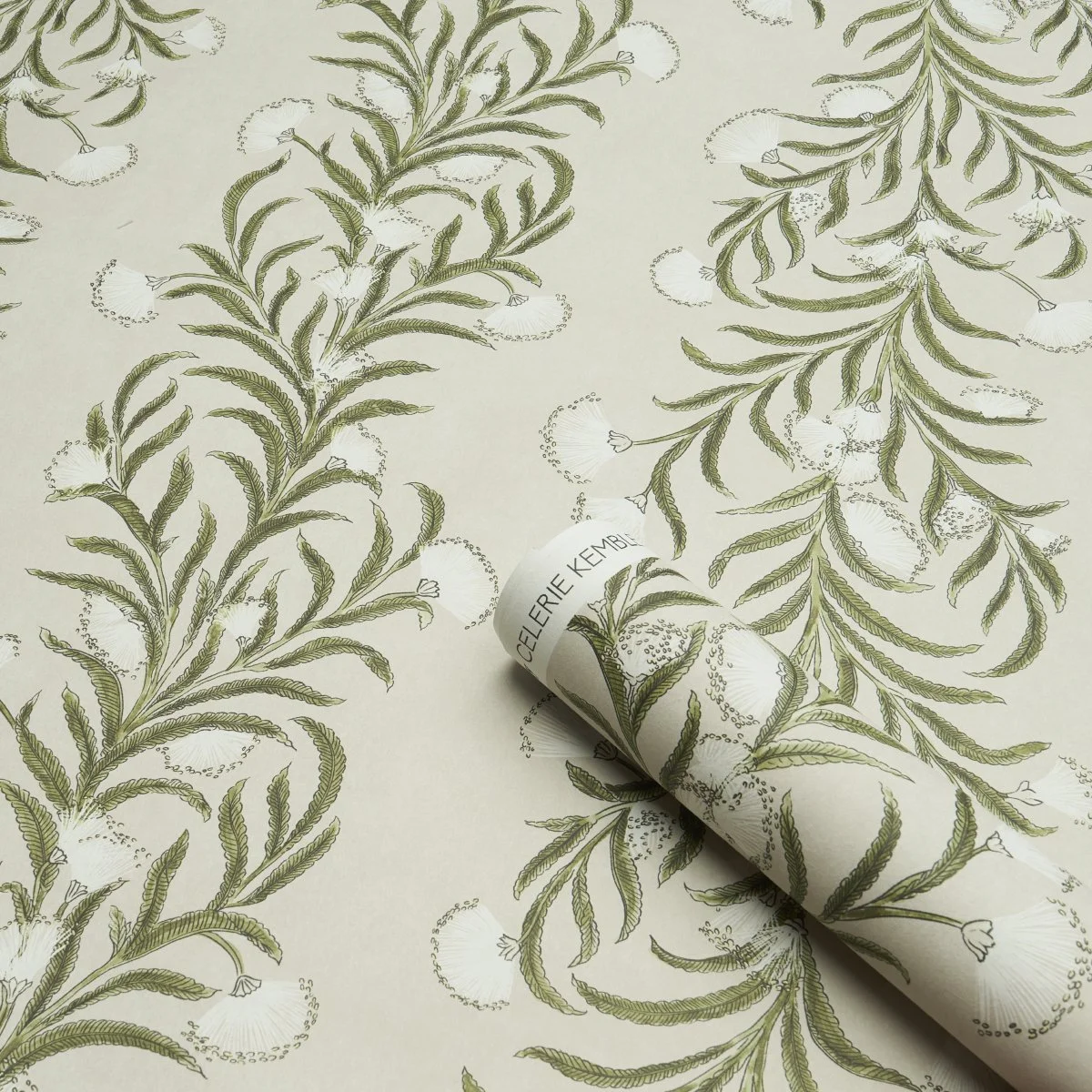
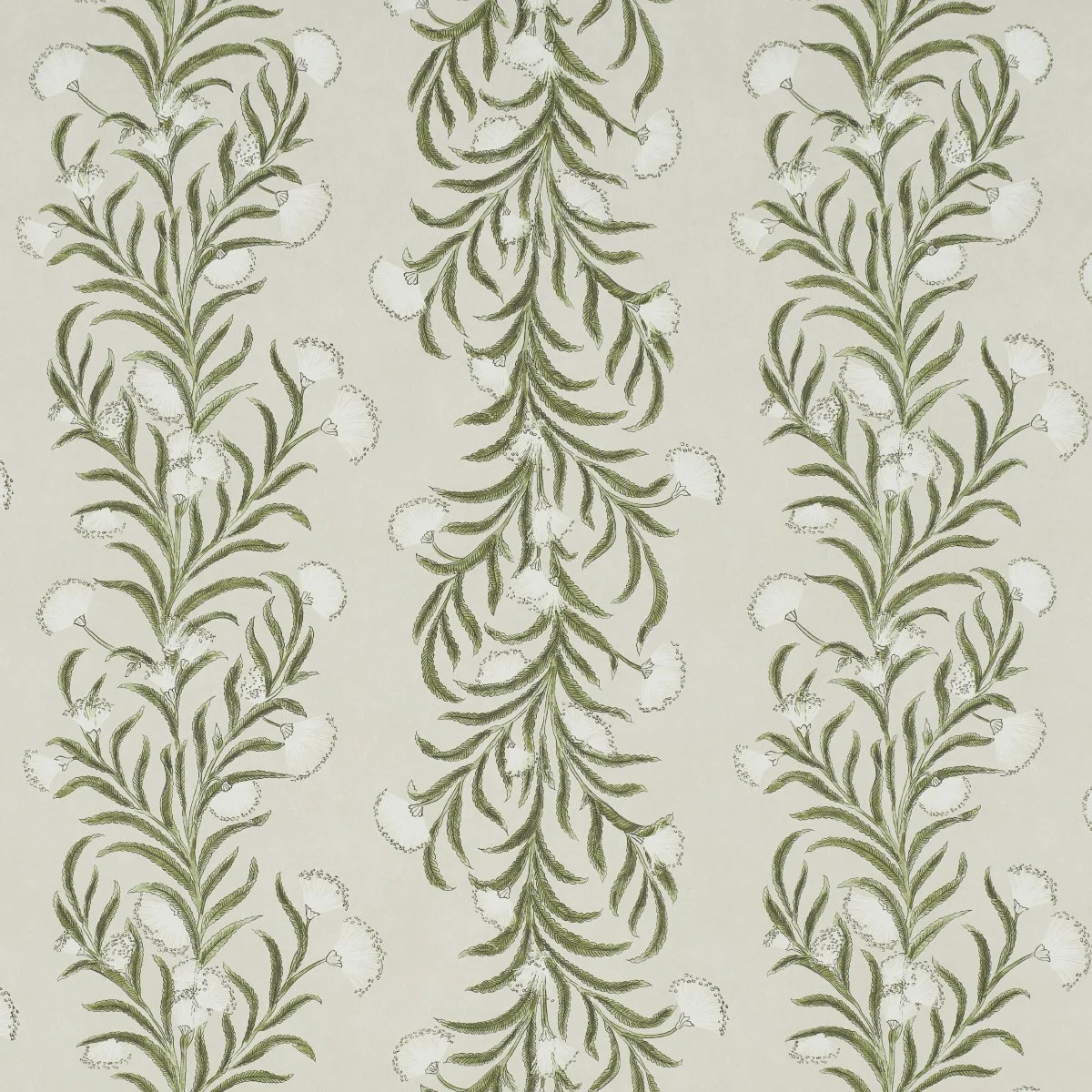
Our lead example is Schumacher Tasmanian Mimosa in Ivory & Green, a wide botanical stripe that shows why scale is more than one number.
What pattern scale actually means
Every Schumacher product page on our shop lists the numbers that tell you most of the story:
Roll width. How wide each strip is. Many patterns are 27 inches. Some, like Tasmanian Mimosa, are 54 inches.
Horizontal repeat. How far across the wall the design runs before it starts over.
Vertical repeat. How far down the wall before it starts over. This one drives waste and yardage.
Match. Straight means the motif lines up level across each seam. Half drop means every other strip drops by half a repeat, which gives a diagonal flow. Random means there is nothing to line up.
Repeat size is not the same as motif size. Greek Key in Mineral has a 13.5-inch horizontal and 20.5-inch vertical repeat, but the spirals inside it are small and tight, so the wall reads as a fine diamond texture. Tasmanian Mimosa repeats every 13.5 inches down, yet its stems run the full height of the wall and read as bold columns.
Judge scale from where you will actually see the wall: the doorway, the sofa, the bed.
Small-scale patterns: texture more than pattern
Small prints read as texture from across the room and as pattern only up close. They are a strong choice for:
Rooms full of art, books, or busy furniture
Hallways and back halls you walk through rather than sit in
Ceilings, where a big print can feel heavy overhead
Any room where you want warmth and depth without a statement
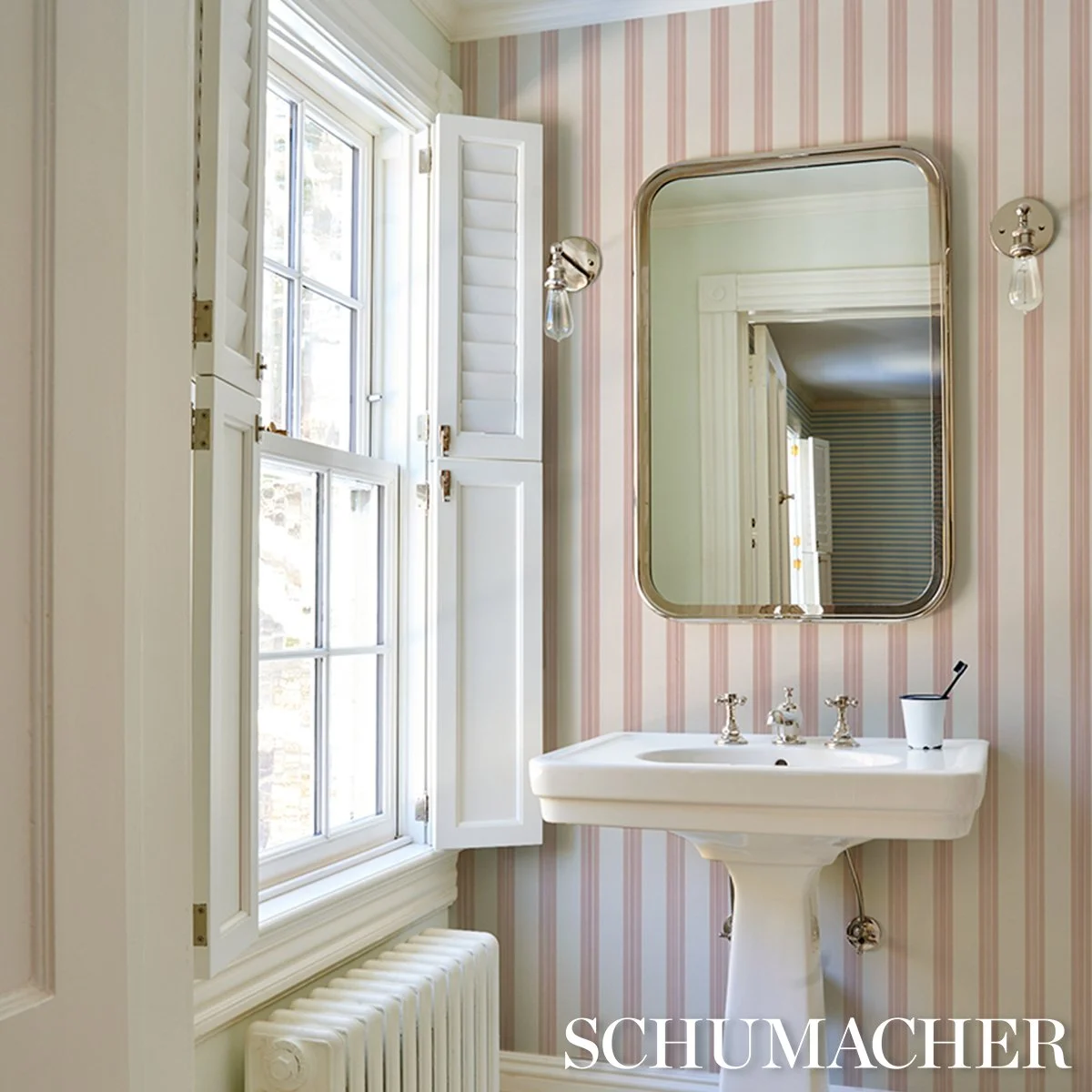
Temple in Straw is a gold-and-cream fret with a repeat under 5 inches each way, printed on a 56.5-inch roll. Chatham Stripe in Rose is a fine multi-width pink stripe on beige with a 3-inch horizontal repeat. We featured its gold sister, Chatham Stripe in Ochre, in October. Metalliferous in Aged Copper goes quieter still: a perforated-dot texture in brown and gold with a random match.
One warning. Small does not mean "for small rooms only." A tiny print in a large room can read as a solid color from the doorway. If that is what you want, good. If you want people to notice the pattern, go up a size.
Mid-scale patterns: the workhorse for most rooms
Mid-scale prints have motifs you can pick out from across the room without them taking over. They suit bedrooms, dining rooms, offices, and guest rooms with normal-size furniture, which is why most of our Abilene clients land here.
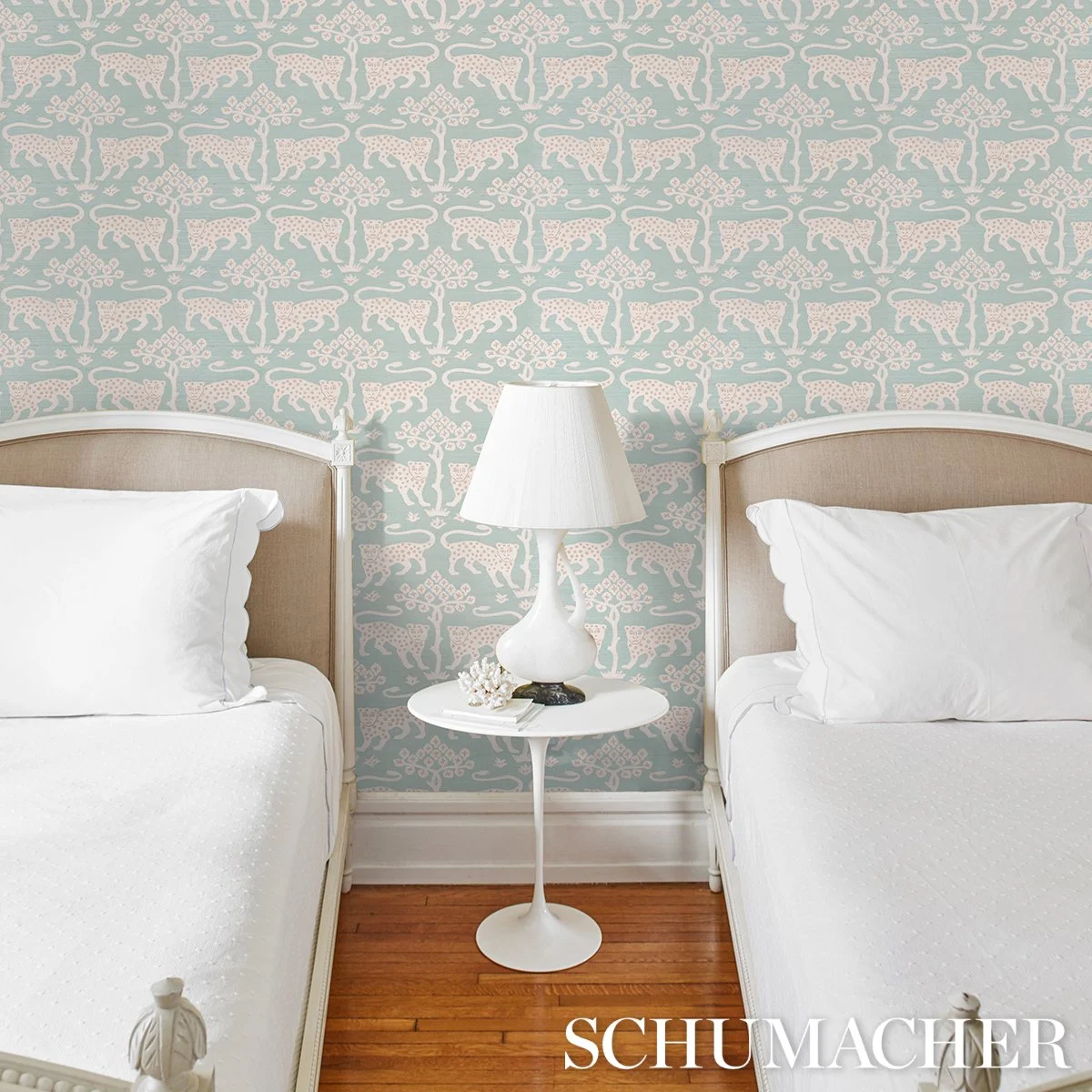
Woodland Leopard Sisal in Waterblue has cream leopards and trees on aqua sisal with a 15-inch vertical repeat on a 34-inch roll.
Queen of Spain in Sky sets soft blue painted teardrops in loose rows on cream.
Poppy Stripes in Blue alternates blue flower sprays with narrow flowering vines on a 54-inch roll.
White Lotus in Cool Gray stacks painted lotus silhouettes into columns, with a half-drop match and a repeat of about 27 inches each way.
Mid-scale reads as pattern from the door and still holds up when you sit next to it. If you are unsure, start here.
Large-scale patterns and murals: let the wall carry the room
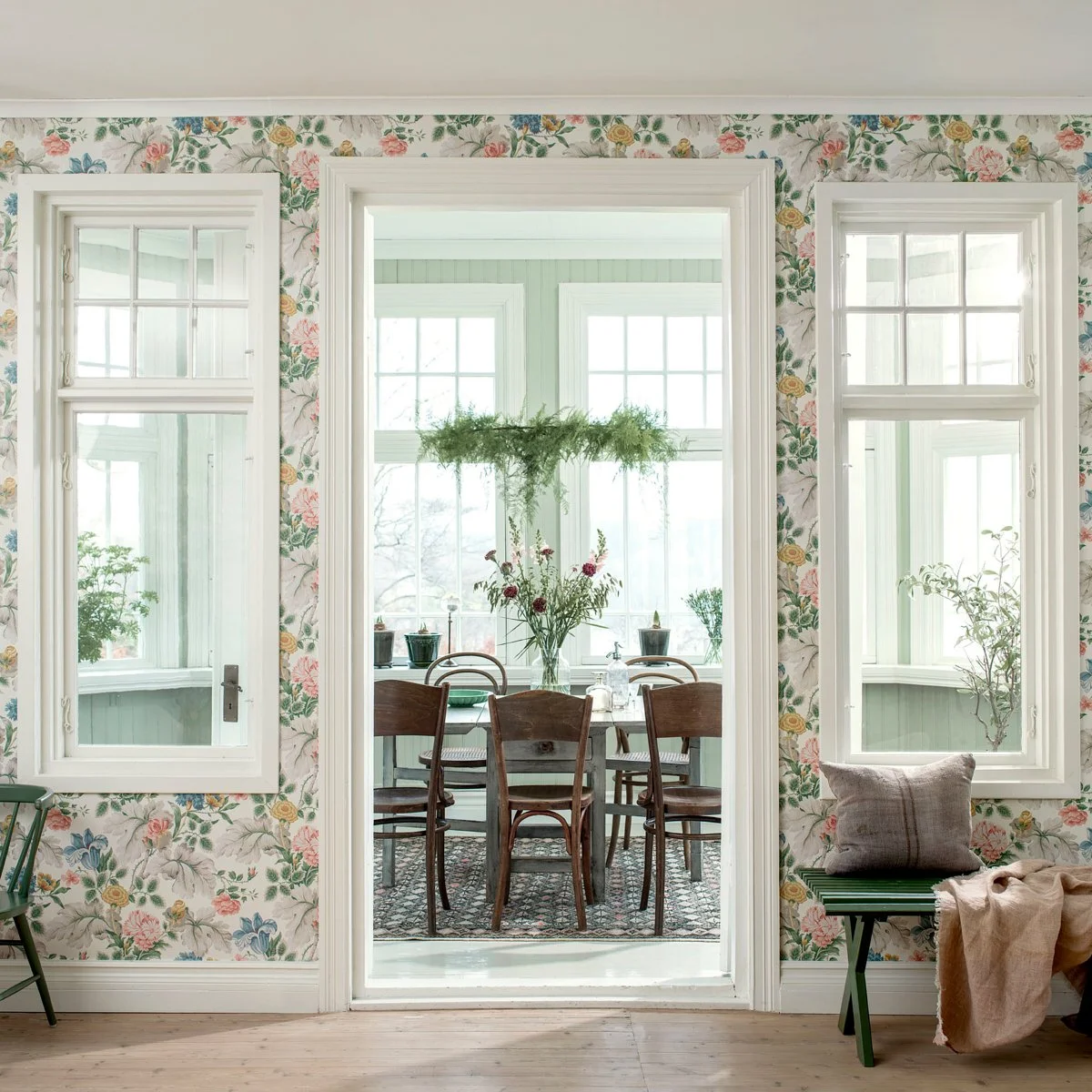
Big prints are not just for big rooms. A large pattern in a small powder room is one of the best uses of wallpaper there is: you see fewer repeats, so it reads like art instead of wallpaper. Large scale works well in:
Powder rooms and small entries, where the pattern wraps you
A focal wall behind a bed, buffet, or sofa
Rooms with tall ceilings that can show a full repeat or more
Rooms with simple furniture that will not compete
Chiang Mai Dragon in Ebony puts the dragon and oversized blooms on solid black, with a 45.75-inch vertical repeat. Pyne Hollyhock in Indigo is large blue hollyhocks on white with a 47.5-inch half-drop repeat; we covered it in our Pyne Hollyhock post. Carnation Garden Mural in Multi is sold by the panel with a 104-inch vertical repeat, so on an 8-foot wall the design never starts over top to bottom.
Watch furniture coverage. If a sofa and a large painting will hide half the wall, a 47-inch motif may only show in pieces. Measure what will actually stay visible.

Tasmanian Mimosa: a large-scale stripe with a short repeat
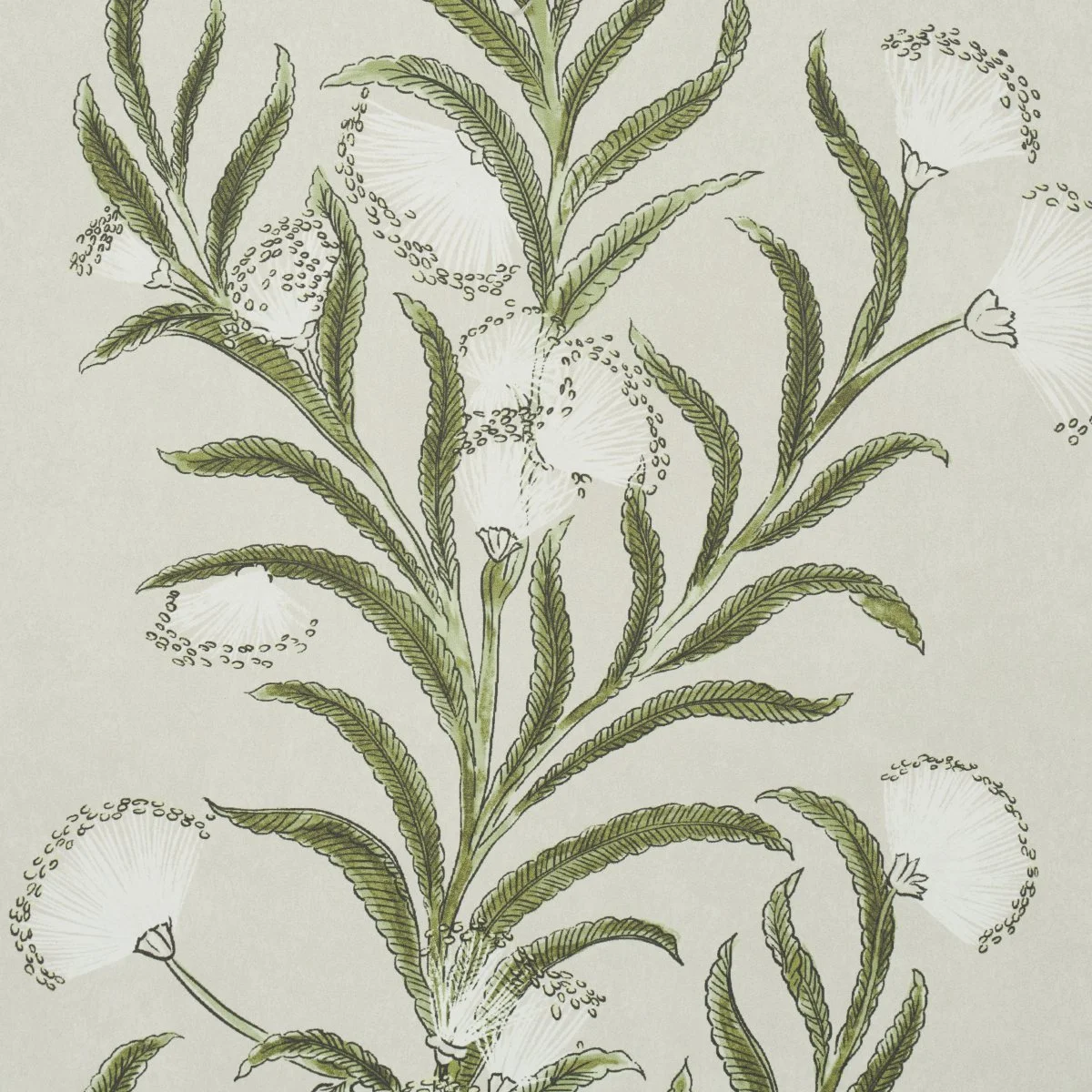
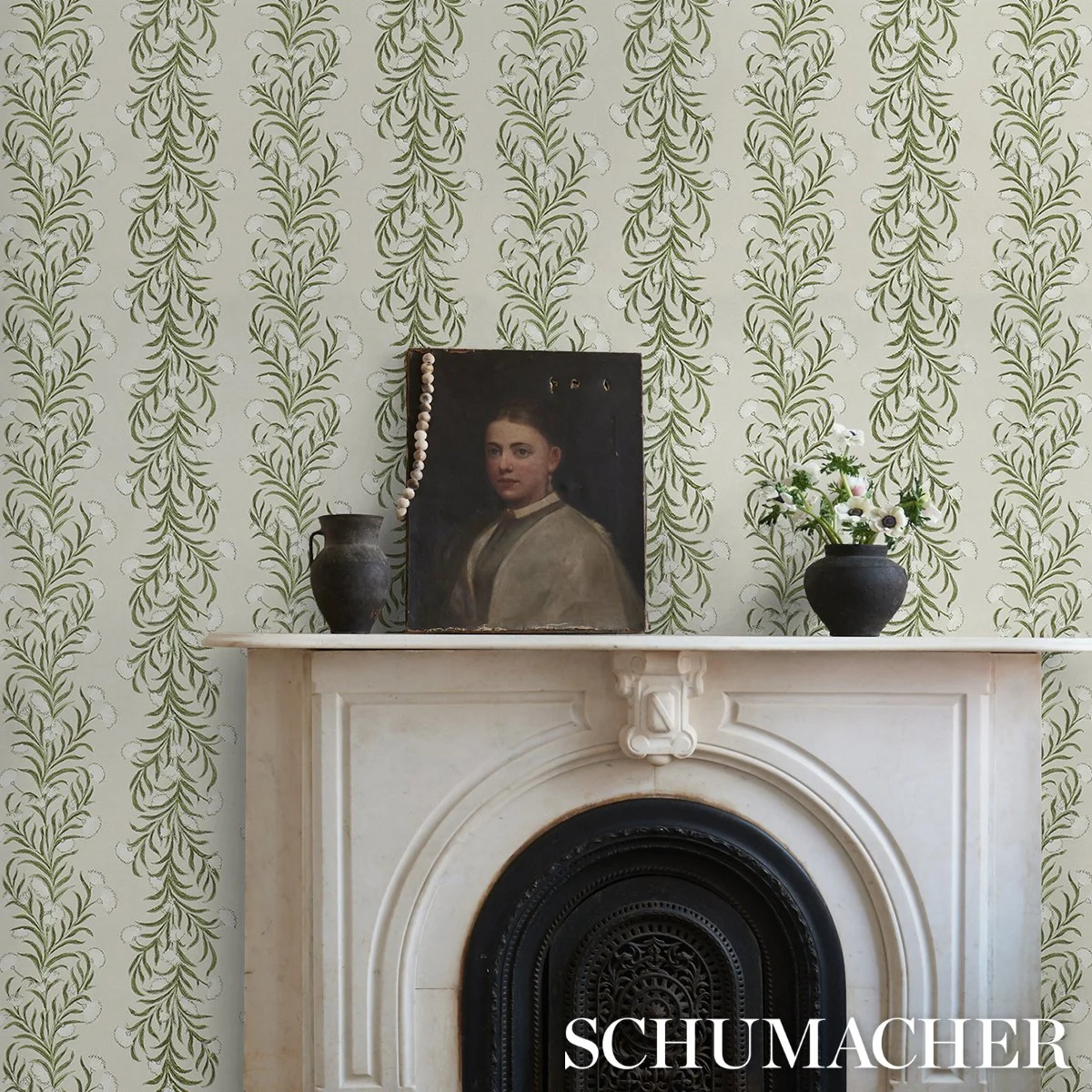
Tasmanian Mimosa in Ivory & Green (SKU 5015362) is a good lesson in reading the photos and the numbers together. The product page calls it a wide-width, large-scale botanical stripe with an undulating quality, a delicate hand-drawn look, and bottle-brush blooms. On the wall you see green leafy stems with white, fluffy blooms climbing in wavy columns on a pale ivory-green ground.
The numbers on the page:
$101.50 per yard; at the 10-yard minimum the page shows a total of $1015.00
Roll width 54", horizontal repeat 18", vertical repeat 13.5", straight match
10.0 yards per roll, order minimum 10 yards, order increment 10 yards
Uncoated non-woven substrate, ASTM E84 Class A flame test, pre-trimmed: No
The page also notes the design is made to order.
From the doorway the columns read big. Up close, the short 13.5-inch vertical repeat means very little paper is lost at the top of each strip. The 54-inch width means a 12-foot wall takes three strips instead of six, so there are fewer seams. It works in a living room with a mantel, a dining room, or an entry, and it pairs easily with a small check or a solid.
Big motif, short repeat
Tasmanian Mimosa's stems read large, but the design repeats every 13.5 inches down the wall. That keeps waste low on every strip, and the straight match lets us line the columns up level across each seam.
Twenty Schumacher patterns, from quiet to bold
If you are building a shortlist, here are 20 patterns on our shop, arranged roughly from the smallest-reading to the boldest. Each line describes what the paper looks like on the wall.
Temple in Straw: A tight gold-and-cream fret, based on a Greek key, that reads as a woven texture from a few feet away.
Metalliferous in Aged Copper: A fine grid of perforated dots in brown and burnished gold that reads almost like a solid metallic.
Chatham Stripe in Rose: Fine multi-width rose-pink stripes on a soft beige ground.
Greek Key in Mineral: Small interlocking square spirals in soft gray, set on the diagonal like a quiet trellis.
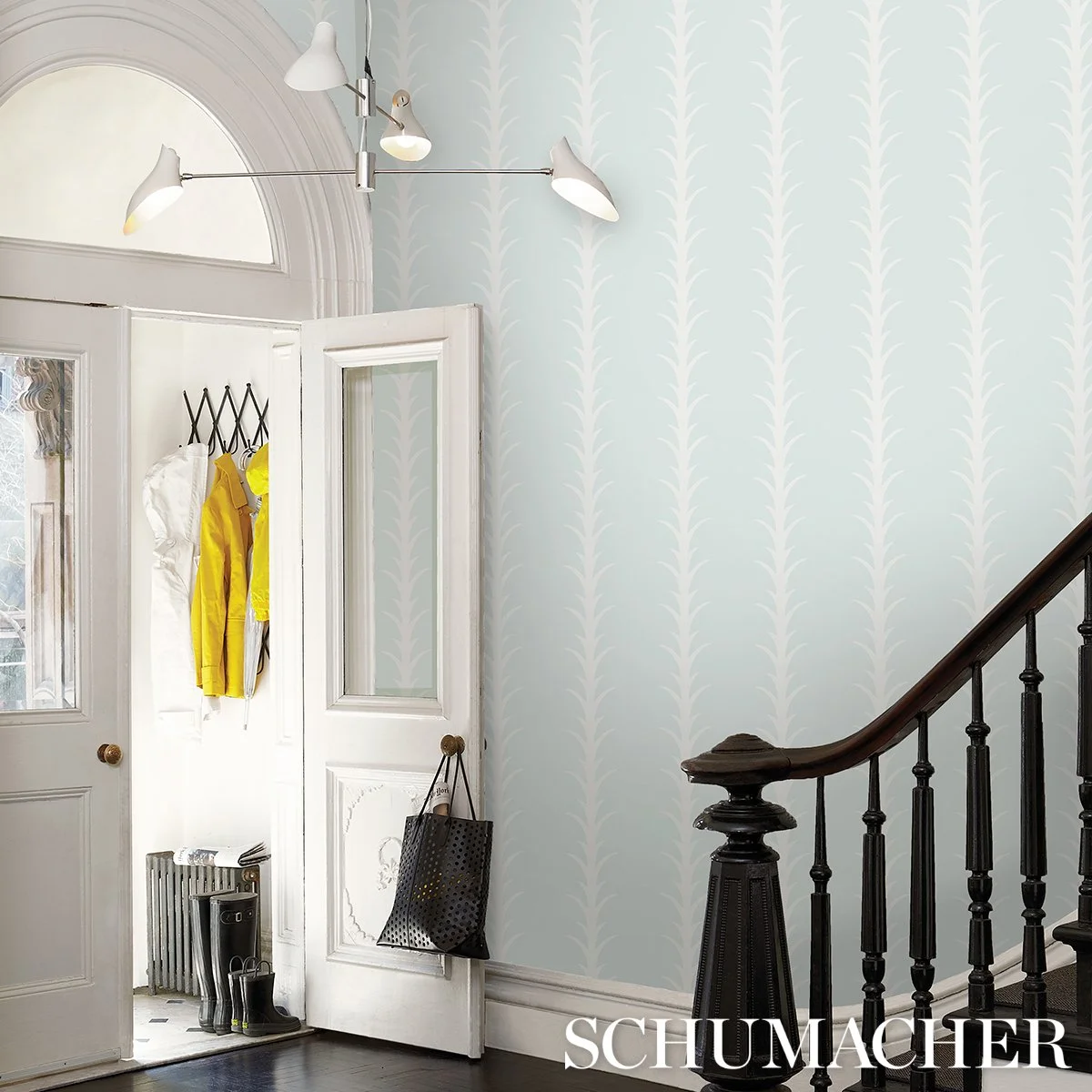
Acanthus Stripe in Ivory on Mineral: Ivory acanthus columns on a dusty seafoam ground, airy and easy to live with.
Acanthus Stripe Sisal in Shadow: The same acanthus columns in ivory on deep charcoal sisal, with the grass grain showing through. See every Acanthus Stripe colorway
Magnolia in Mineral: Pale pink magnolia blossoms on dark brown branches over a fine gray-brown geometric lattice.
Woodland Leopard Sisal in Waterblue: Cream leopards and stylized trees in a mirrored repeat on soft aqua sisal.
Queen of Spain in Sky: Rows of soft duck-egg painted teardrops on cream, a mid-century design from 1963. See every Queen of Spain colorway
Poppy Stripes in Blue: Blue stylized flower sprays on green stems, set between narrow flowering vines and pale blue bands on white.
White Lotus in Cool Gray: Painted gray lotus silhouettes stacked into bold vertical columns on an off-white ground.
Ocean Toile in Delft: An undersea toile of feathery cerulean fronds on bright white, based on an 18th-century document. See every Ocean Toile colorway
Hydrangea Drape in Grisaille: Gray hydrangea and leaf vines alternating with ribbed drapery stripes; the design made its film debut in 1939.
Tasmanian Mimosa in Ivory & Green: Green leafy stems and white bottle-brush blooms climbing in wavy columns on pale ivory-green.
Cranley Garden in Document: Birds, butterflies, and flowering branches in pink, blue, and green on cream, revived from the archive.
Pyne Hollyhock in Indigo: Large hollyhock blooms in layered blues on crisp white, a classic chintz.
Ananas in Tropical: Pineapples tucked among oversized leaves in orange, pink, green, and teal, a 1930 design.
Night at the Opera in Deep Blue & Olive: Hand-painted columns of olive squiggles, navy bands, and icy blue fretwork.
Chiang Mai Dragon in Ebony: A dragon among oversized peonies and blooms in pink, lime, and mustard on solid black.
Carnation Garden Mural in Multi: Giant carnations, cornflowers, and dove-gray leaves on cream, sold by the panel.
Sample first, then run the numbers
Scale is the hardest thing to judge on a screen. Before you order, add a $3.00 memo sample to your cart from any product page (our Schumacher wallpaper samples guide explains how it works). Tape it at eye level, then step back to where you usually sit or stand. Look in daylight and again under lamps. Order a small, a mid, and a large print at the same time and compare them on the same wall.
For a large print, a memo shows only part of the motif. Use the room photos on the product page to judge the full scale.
Then use the Wallpaper Calculator on the product page. Per the calculator logic, each strip starts at wall height plus 4 inches and is lengthened to the next full vertical repeat. Here is how scale changes the order for the same 8-foot-tall, 12-foot-wide wall:
Tasmanian Mimosa (54" wide, 13.5" repeat, 10-yard rolls): each strip is 108 inches, so one roll gives three strips. Three strips cover the wall, so one roll (10 yards) does it.
Chiang Mai Dragon in Ebony (27" wide, 45.75" repeat, 4.5-yard single rolls at $724.50 each): each strip is 137.25 inches, so one roll gives one strip. The wall needs six strips, so six single rolls.
Same wall, very different order. Large repeats on narrow, short rolls use more paper. Chiang Mai Dragon is also a half-drop match, so we check the layout on site before final quantities. Minimums and units vary by pattern (yard, single roll, or panel), so confirm the unit on each page.
If you are in Abilene or nearby, we can measure for you and bring samples to the house. If you are farther away, you can still order Schumacher wallpaper online through our shop with nationwide shipping.
How a professional installer handles scale
Scale decides where the cuts land. On every pattern, large or small, we:
Skim and prime so the paper lays flat and the seams stay tight
Center the main motif on the focal wall, fireplace, or bed so the best part of the pattern lands where eyes go
Set the first strip so the repeat sits level at eye height and the cut pieces fall near the ceiling or baseboard
Plan the last seam, where the pattern meets itself, in a corner or behind a door
Snap a plumb line on every wall, because a stripe shows any lean
Follow the half-drop sequence strip by strip on patterns that use one
Trim edges by hand on papers listed as not pre-trimmed, like Tasmanian Mimosa
People often ask how much it costs to install wallpaper. The honest answer depends on wall height, prep, and how many cuts the pattern needs, so we quote after we measure. For the full walkthrough, read What to Expect During a Professional Wallpaper Installation.
Why Abilene homeowners call Wallpaper Abilene
We are a local install company that also sells Schumacher wallcovering online. That means in-home sample showings for local clients, professional installation, and nationwide shipping when you are ordering for a project we are not hanging. We will also tell you honestly when a pattern is the wrong scale for your room, even if it is the one you fell for first.
Ready to Find the Right Scale for Your Room?
If one of these patterns fits your room, shop it, order a sample, or book an in-home wallpaper showing and we will hold samples up on your own walls with you.
